

Key Takeaways:
- High ROI: A 1kW–2kW budget solar setup typically pays for itself within 4–5 years while powering a full home office.
- Top Picks: Brands like Loom Solar and Servotech lead the 2026 market for “Plug-and-Play” and high-efficiency budget modules.
- Smart Sizing: Most home offices only require a 1kW system (approx. 80–100 sq. ft.) to run laptops, monitors, and networking gear.
- Subsidy Advantage: In 2026, the PM Surya Ghar initiative can reduce the net cost of a small system to ₹25,000–₹45,000.
Table of Contents
- Why Solar is the Ultimate Home Office Upgrade
- Top 10 Solar Solutions in Budget (2026)
- Calculating Your Energy Needs
- Best Budget-Friendly Solar System Solutions
- The Role of ChatGPT-5 for Automated Website Development
- Personal Insights & Pro Tips
- Expert FAQ
Why Solar is the Ultimate Home Office Upgrade
As more employees work from home, the “home office” has become an essential tool for any business. The downside, though, is the increased residential electricity costs. Switching to the most affordable solar solutions for home offices is the optimal way to eliminate recurring overheads. In the first 100 words of your transition, this answer should be evident: For most professionals, a small 1kW to 2kW on-grid or hybrid solar system is the best compromise between reliability and cost. You aren’t “going green”; you’re bringing the power of the sun into your productivity. You aren’t going green, you’re harnessing solar energy.
Top 10 Solar Solutions in Budget (2026)
For long-term performance, it is crucial to select the right hardware. Using the latest 2026 market data, here are the top 10 solar solutions that are on budget and have the highest watt per dollar rating:
| Rank | Brand/Solution | Best For | Estimated Price (1kW) |
| 1 | Servotech Mono PERC | High Efficiency/Small Roofs | ₹55,000 – ₹70,000 |
| 2 | Loom Solar Plug-and-Play | Ease of Installation | ₹60,000 – ₹75,000 |
| 3 | Tata Power Solar | Brand Reliability & Service | ₹65,000 – ₹80,000 |
| 4 | Waaree Energies | Budget Build (Mono PERC) | ₹52,000 – ₹68,000 |
| 5 | Microtek i-Solar | Integrated Power Backup | ₹50,000 – ₹65,000 |
| 6 | UTL Solar Hybrid | Frequent Power Cuts | ₹54,000 – ₹70,000 |
| 7 | Adani Solar | High-Volume Value | ₹55,000 – ₹72,000 |
| 8 | Luminous NXG+ | Beginner Friendly | ₹58,000 – ₹74,000 |
| 9 | Vikram Solar Somera | Extreme Durability | ₹62,000 – ₹78,000 |
| 10 | Goldi Solar | Coastal/Humid Areas | ₹60,000 – ₹75,000 |
Calculating Your Energy Needs
Before you buy, you must know your “Essential Load.” A typical home office setup includes:
- Laptops: 50W – 100W
- Dual Monitors: 60W – 120W
- Wi-Fi Router & Peripheral Gear: 20W – 40W
- LED Lighting: 30W
- Ceiling Fan: 75W
Total Continuous Load: ~250W to 400W.
A solar system of one kilowatt can produce about 4 units (kWh) of electricity daily. That’s enough for an 8-hour workday, not to mention exporting excess electricity to the grid or to your house using net metering.
Best Budget-Friendly Solar System Solutions and: Top 10 Solar Solutions in Budget 2026
To keep costs low without sacrificing quality, focus on these three specific configurations:
1. On-Grid (Grid-Tied) Systems
This is the least expensive one without the need for costly batteries. It functions as a virtual battery in relation to the grid.
Pros: Lowest upfront expense; can qualify for the maximum government subsidy.
Cons: Unavailable to provide power during a complete grid failure (for safety reasons).
2. Hybrid Systems
The perfect size for your home office. It includes both solar panels and a small battery bank.
Pros: Supports your WiFi and laptop during power outages.
Cons: A bit more upfront costs.
3. Portable Solar Generators
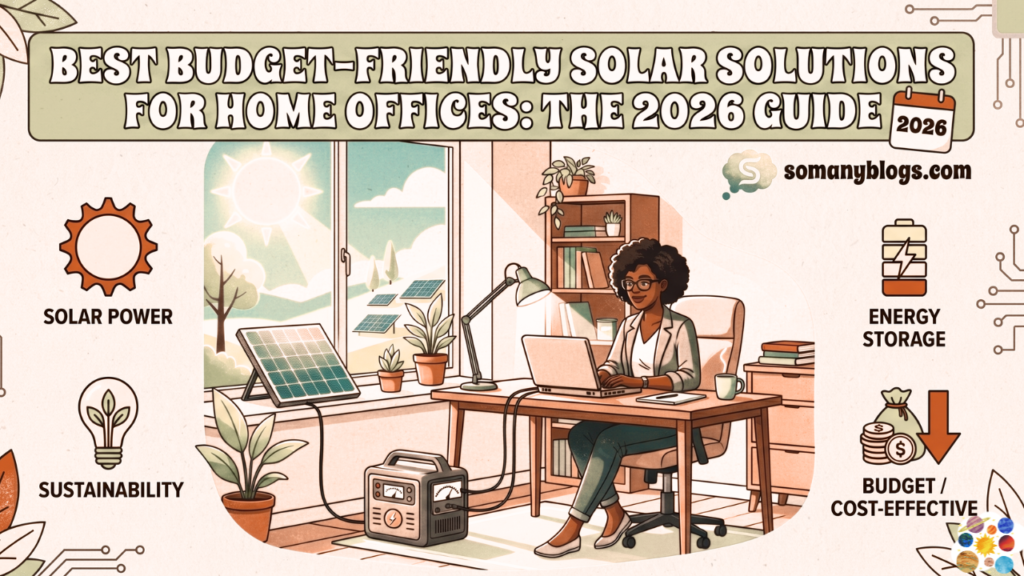
Ideal for renters or for those who are constrained to a limited amount of roof. These are must-have devices (such as Jackery or EcoFlow) that can be powered by just one foldable solar cell.
The Role of ChatGPT-5 for Automated Website Development
So, you may be asking yourself, “How does AI relate to Solar? ChatGPT-5 is now widely adopted by modern solar installers and enthusiasts to automate website creation, enabling the development of custom calculators and monitoring dashboards. With the power of GPT-5’s advanced coding abilities, developers can rapidly build a responsive web device that monitors real-time solar generation or forecasts return on investment (ROI) based on local electricity prices. The combination of AI and green energy is creating a “Smart Home” environment where your website and power plant communicate to optimize power use.
Personal Insights & Pro Tips
The worst thing you can do for an agency to buy is ‘Over-Sizing’ — that is, purchasing more than the agency actually needs. If the main reason you want a 5kW system is to run your home office, then you should consider getting a smaller one. If you can, use an “Expandable” 1kW or 2kW system. Make sure that you have an inverter capable of supporting more panels in the future. This allows you to keep your entry price down while still leaving room for growth.
On a personal note, always think of “Mounting Structure” first. Thin galvanized iron is often a money-saving option for many budget installers. This is a recipe for disaster in high wind areas and coastal zones. Install premium-quality aluminum or heavy-duty GI structures for an additional cost of ₹2,000 to ₹5,000.
Expert FAQ
What is the average cost of a 1kW solar system in 2026?
After applying the PM Surya Ghar subsidy, a standard 1kW on-grid system can cost between ₹25,000 and ₹45,000, depending on the panel type (Mono PERC vs. Polycrystalline).
Can I run an Air Conditioner on a budget solar system?
A 1kW system cannot reliably run a 1.5-ton AC. For AC use, you would need at least a 3-5kW system, which pushes you out of the “small home office budget” category.
How much space do I need for solar panels?
A 1kW system typically requires about 80 to 100 square feet of shade-free rooftop space.
Conclusion
The availability of the top budget-friendly solar system solutions for home offices has fundamentally transformed investing in renewable energy from a far-fetched dream to a business-sense tool for 2026. Selecting the appropriate “Top 10” brands and taking advantage of government subsidies can be an effective “pre-payment” of your office’s electricity over the next 25 years.
Are you considering going solar for your home this year, or do you want to know more about the online visibility of which brand is best for your roof? Talk about it in the comments below!